Key points
- Choose the Panasonic F-YZX60B-H if laundry stays damp in a cold room after you improve the setup, and you can accept its power use and heat.
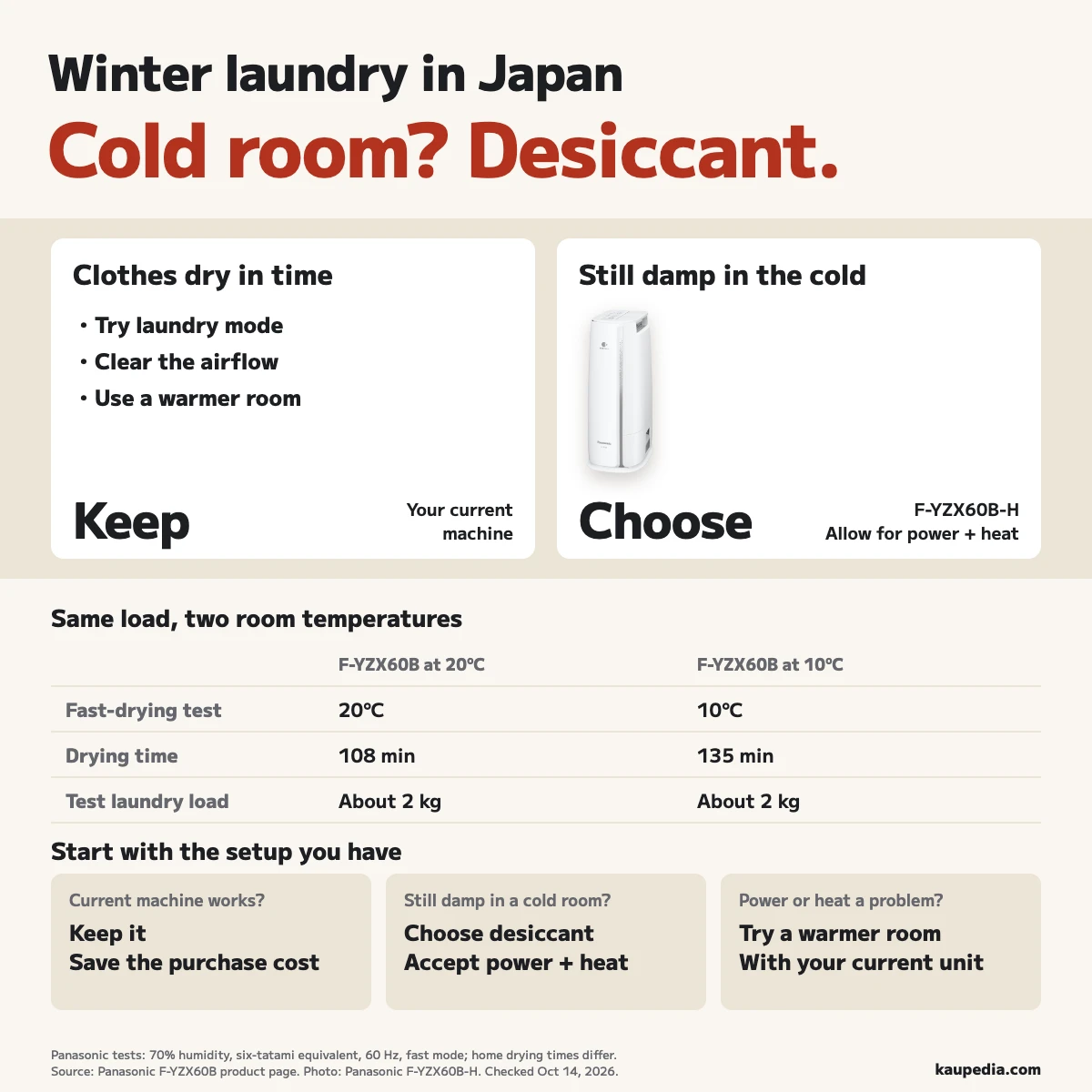
- The same model took about 108 minutes at 20°C and 135 minutes at 10°C in Panasonic's fast-drying tests; home results will differ.
- Keep your current machine if a laundry or winter mode dries your usual load in time. A smaller amount of tank water alone is not a reason to replace it.
If laundry stays damp in your cold room in Japan after you improve the setup, choose a desiccant dehumidifier such as the Panasonic F-YZX60B-H. It uses a moisture-catching material and a heater, so it is better suited to cold rooms than a machine that relies on cooling air to collect water. Try your current machine's laundry or winter mode first, and replace it only if clothes still miss your drying deadline and you can accept the extra power use and heat.
Why a cold room changes the right choice
A compressor dehumidifier makes a surface cold enough for water in the air to turn into drops. In winter, there is less water in the air at the same relative humidity. Frost can also form on the cold surface, and removing it pauses moisture collection.
That explains why your tank may fill more slowly even when the humidity meter still reads high. It does not prove the machine is broken. Judge it by whether your towels dry when you need them, rather than by how much water you empty.
A desiccant model catches moisture in a material called zeolite. A heater releases that moisture so it can be collected in the tank. This approach works better in cold rooms, but the heater costs electricity and the unit releases heat.
Winter alone is not a reason to buy one. A heated drying room may suit your current compressor machine, and some compressor models have a winter setting with extra heat. Use that option if it already does the job.
Try one normal load before replacing your machine
Start with the load you actually need dry: tomorrow's shirt and towels, for example. Keep the load, hanging space, and start time similar when comparing setups. Record the room temperature, selected mode, and whether thick seams are dry by your usual deadline.
- Choose the right mode. Look for 衣類乾燥, meaning laundry drying. If your model has 冬モード, meaning winter mode, use it as its manual directs. An automatic room-humidity setting may stop removing moisture while clothes are still wet.
- Clear the air path. Clean the filter as directed, empty the tank, and spread clothes apart. Aim the airflow across the whole load, rather than at one towel.
- Try a warmer room if one is available. Keep the machine away from a heater itself. Nearby heat can affect its sensor; a heated room and a position beside a heater are different things.
If this gets your clothes ready in time, keep the machine. If towels remain damp and you cannot use a warmer room, a desiccant model is the better choice. A clothes rack packed with wet fabric needs a better layout before it needs a new appliance.
What Panasonic's winter test tells you
The F-YZX60B took longer in the cold test, even though it uses the desiccant method. Here is the comparison from Panasonic's product page, with the load and drying mode kept the same.
Test condition | Warmer-room test | Winter test |
|---|---|---|
Room temperature | 20°C | 10°C |
Relative humidity | 70% | 70% |
Laundry amount | About 2 kg | About 2 kg |
Room and power frequency | Six-tatami equivalent, 60 Hz | Six-tatami equivalent, 60 Hz |
Mode | Fast drying | Fast drying |
Reported drying time | About 108 minutes | About 135 minutes |
The cold result is 27 minutes longer, or about 25%. This is useful evidence of low-temperature drying, rather than a promise that your clothes will finish in just over two hours. Panasonic also fixes the hanging pattern and airflow in the test.
A load of hoodies or thick bath towels is not the same load. Nor should a result measured at 60 Hz be presented as a separate test for every home in Japan. Use the comparison to choose a method, then judge your own laundry by its actual dry finish.
Budget for the mode and the time it runs
The F-YZX60B's standard laundry mode is rated at 295 W; fast drying is rated at 465 W. At Panasonic's reference electricity rate of JPY 31 per kWh, four hours at those powers would cost about JPY 37 and JPY 58 respectively.
The formula is simple: power in kilowatts × hours × your electricity rate. Four hours of fast drying every day for 30 days would be about JPY 1,730. That estimate covers only this machine's electricity, with no room-heating cost or purchase price included.
A lower hourly cost and a cheaper finished load are different comparisons. Panasonic's warmer-room test used 0.71 kWh in standard mode and 0.84 kWh in fast mode to dry the load. Standard was slower but used less energy in that test.
Your bill will differ with the room, load, tariff, and automatic controls. Standard mode can switch to lower-power fan operation, so the four-hour example assumes steady rated power rather than predicting one real cycle. Choose standard when there is time; use fast drying when the deadline matters more.
For a drying room of 12 m² in a wooden building, this model matches Panasonic's room-area guidance. If your current setup still leaves laundry damp, compare the F-YZX60B-H's current total price with how often you need it: four hours of fast drying is about JPY 58 at the reference rate, before any heating cost.
 View on Amazon Japan
Make room for the tank, airflow, and sound
Japanese room-size labels depend on the building. Panasonic lists 木造, wooden construction, at 12 m²; プレハブ, prefabricated construction, at 18 m²; and 鉄筋, reinforced-concrete construction, at 23 m². These are dehumidifying-area guides, not promises that a full laundry load will dry equally quickly in each space.
If you do not know the building type, use the smaller area as a cautious starting point. Measure the actual drying room rather than choosing from the whole apartment's floor plan. A six-tatami test room is a test condition, not the machine's only permitted room size.
The unit weighs about 6 kg and holds about 2 L of water. It stops when the tank is full, so empty it before starting a load. A compact tank helps with carrying, but a long drying session may need an extra trip to the sink.
Keep clothes at least 40 cm from the air outlet. Allow 100 cm above the unit and 20 cm at the front and sides; rear clearance depends on the louver position. The placement diagram on page 7 of the Japanese manual shows the arrangements. Keep required home ventilation running.
Standard and fast laundry drying are both rated at 48 dB. The reduced-noise mode is rated at 39 dB on 50 Hz power and 38 dB on 60 Hz power, with a longer test drying time. Two matte-gray owner reviews describe useful drying alongside louder operation, so choose a daytime drying spot if sound would keep you awake.
Avoid these common winter buying mistakes
Treating litres per day as a winter laundry timer. This model's rated water-removal capacity is measured while the room stays at 20°C and 60% humidity. It cannot tell you when a cold hoodie will be dry.
Buying desiccant because it must be silent. The heater method says how moisture is removed, not how loud the fan is. Compare the noise figure for the mode you plan to use.
Running below the model's temperature limit. The F-YZX60B's stated operating range is about 1–40°C, with humidity of about 20% or higher. Operation near the lower limit does not mean the same drying time as a warm room.
Choosing a similar-looking listing. The recommended product is F-YZX60B-H in matte gray. The -C color and Panasonic's F-YEX models are different listings. On Amazon Japan, compare the seller, warranty, delivery date, and total delivered price for the exact -H model.
Where to buy
Check prices, availability, shipping, returns, and any subscription terms at the retailer. Links may include affiliate links.
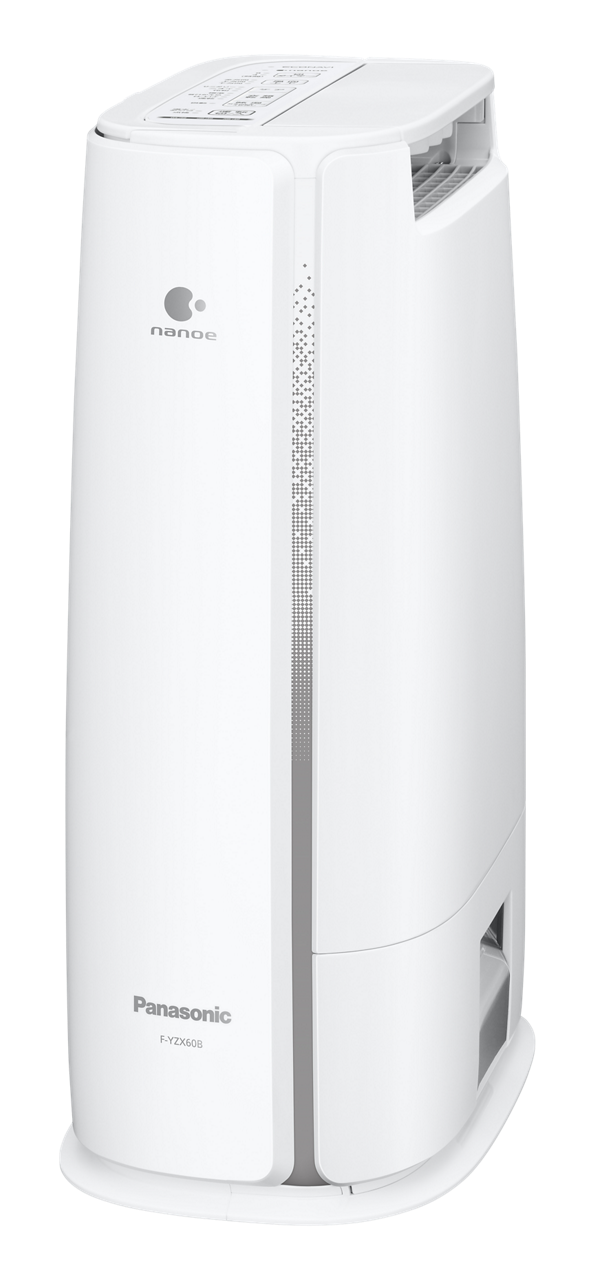
Panasonic F-YZX60B-H Desiccant Laundry Dehumidifier — Matte Gray
Cold-room laundry: Panasonic F-YZX60B-H, price varies
- Good for
- People whose laundry remains damp in a cold room after trying their current machine's suitable mode, clear airflow, and a spaced-out load.
- Before you buy
- Standard laundry drying uses 295 W and fast drying uses 465 W. Both are rated at 48 dB. The unit releases heat and has an approximately 2 L tank. Compare the current seller's total price, warranty, and delivery date.
Specifications and terms
- Method
- Desiccant (zeolite)
- Laundry power
- Standard 295 W; fast drying 465 W (50/60 Hz)
- Laundry noise
- Standard and fast 48 dB; reduced-noise 39 dB at 50 Hz / 38 dB at 60 Hz
- Room-area guide
- Wooden 12 m²; prefabricated 18 m²; reinforced concrete 23 m²
- Tank and weight
- Approximately 2 L, with full-tank stop; 6.0 kg
- Price
- Varies by retailer; compare the total delivered price for F-YZX60B-H
Sources
- Panasonic F-YZX60B — product and winter drying test
Checked October 14, 2026. Approximately 108 minutes at 20°C and 135 minutes at 10°C; approximately 2 kg of laundry, 70% humidity, six-tatami room equivalent, 60 Hz, fast-drying mode, and the stated hanging pattern.
- Panasonic F-YZX60B — specifications
Checked October 14, 2026. Mode-specific power and noise, room-area guidance by building type, tank, weight, and dimensions. Electricity examples use Panasonic's reference rate of JPY 31/kWh.
- Panasonic F-YZX60B — Japanese instruction manual
Checked October 14, 2026. Pages 7, 9–12, 15, 18, 21–23 and 26; placement, Japanese controls, operating range, automatic stopping, cleaning, and energy to dry the test load. The rated daily extraction test maintains 20°C and 60% humidity.
- Panasonic — how dehumidifier types work
Checked October 14, 2026. Compressor cooling, desiccant moisture capture and heater use, and the tradeoff between cold-room use, electricity, and heat.
- Mitsubishi Electric — why compressor dehumidifiers collect less water in winter
Published December 1, 2025; checked October 14, 2026. Less airborne water at low temperatures, frost, defrost pauses, and model-specific low-temperature operation.
- Corona H series — winter laundry mode
Checked October 14, 2026. Example of a compressor model with heater-assisted winter drying; a reason to try an existing machine's suitable mode before replacing it.
- Panasonic — electricity cost FAQ
Checked October 14, 2026. Reference electricity rate and the warning that standard and reduced-noise modes may switch to lower-power fan operation as room conditions change.
- Yahoo! Shopping — F-YZX60B owner reviews
Checked October 14, 2026. Matte-gray reviews dated May 28 and April 3, 2025 describe effective laundry drying alongside noise concerns. These reports do not establish a drying-time guarantee or a measured room temperature.
Found an error or outdated information? Contact us or use our corrections form (opens in a new tab).