Key points
- Consider E1540 for smooth, ordinary single-pane glass that still gets wet after reducing excess moisture.
- Keep E1540 off Low-E, wired, and vacuum double glazing. If the glass type is unknown, wait before buying.
- One pack contains one 90 × 180 cm sheet. Measure each pane and keep the stripes horizontal when planning cuts.
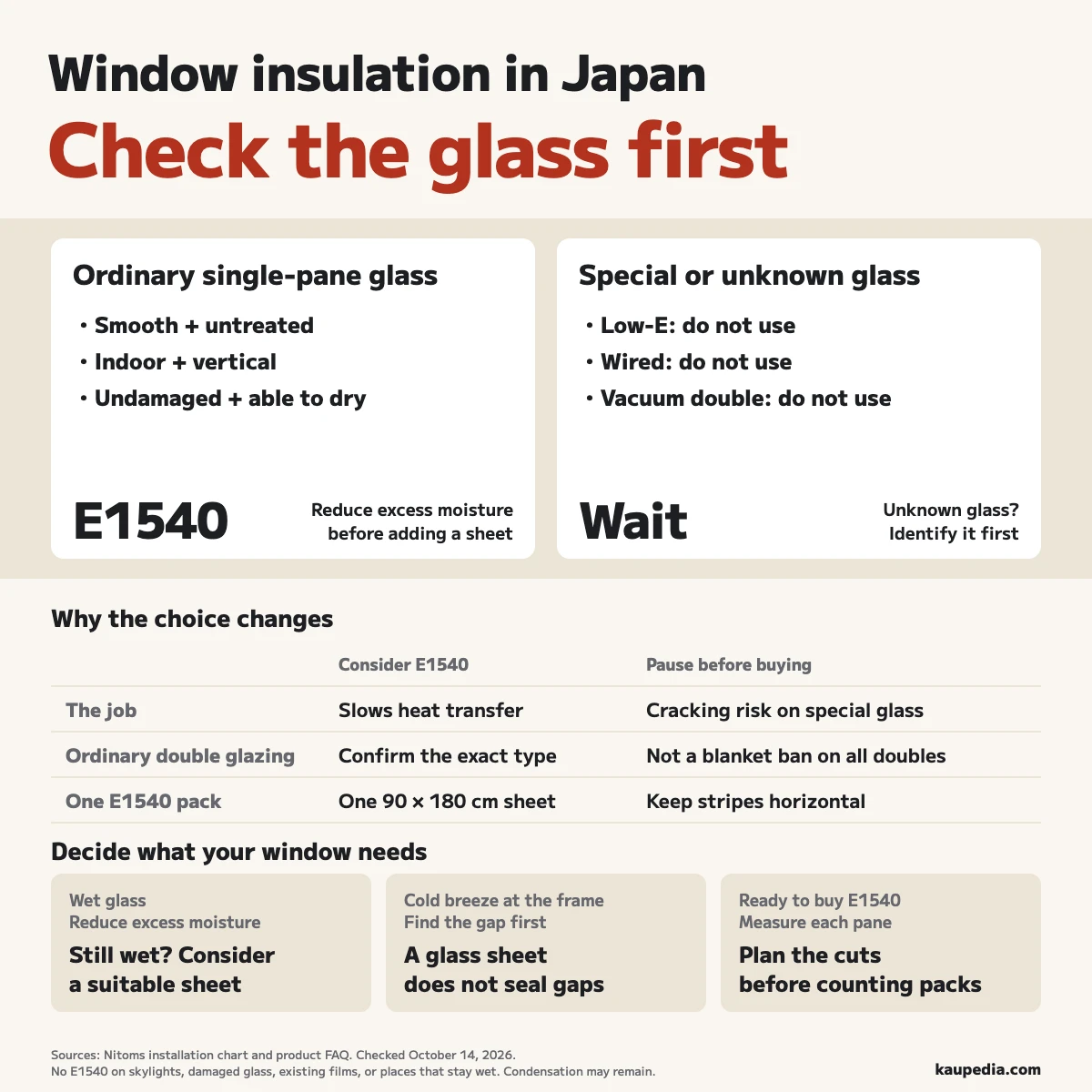
For a Japanese rental with smooth, ordinary single-pane glass, choose Nitoms E1540 if the window still gets wet after you reduce excess moisture. Its air layer slows heat transfer, helping the room-facing surface stay warmer. If your glass is Low-E, wired, vacuum double glazing, or unknown, leave this sheet off your shopping list.
Identify your glass before buying a sheet
A pane is one piece of glass within a window frame. A sliding balcony window may have several panes, and they may have different surfaces. Look at each one, rather than treating the whole window as a single item.
Use these branches for E1540:
- Smooth, ordinary single-pane glass: consider the sheet if the glass is undamaged and untreated. Use the indoor face of a vertical window, in a place where the application water can dry.
- Wired glass: metal wires are visible inside the glass. Keep E1540 off it.
- Low-E glass: this has a special coating. A clear-looking pane is not enough to rule it out; use the window's label or building records.
- Vacuum double glazing: two panes with a vacuum between them. E1540 is unsuitable.
- Rough glass, existing films, cracks, or skylights: choose another approach. Water application needs a suitable smooth surface; adding tape changes the removal risk.
- Ordinary double glazing or an unknown type: pause. Nitoms' Japanese installation chart allows smooth ordinary double glazing, while its FAQ excludes special structures, including vacuum and gas-filled types. Two panes alone do not settle the choice.
If the label is missing, send the property manager a photo and ask for the glass type and model. Then use that information to confirm suitability with the manufacturer. In a rental, the building's rules matter as well as the product instructions.
The reason for these limits is thermal cracking: different parts of a pane warm and expand by different amounts. Insulation can increase that difference. LIXIL describes a household where wired glass cracked after an insulating covering was added. A sheet sticking successfully does not prove the glass is suitable.
Treat moisture and cold glass as two separate problems
Condensation is water forming on a cold surface. The dew point is the temperature at which that water starts to form. Whether a window gets wet depends on both the moisture in the air and how cold the surface becomes.
That gives you two ways to help: reduce excess moisture, or make the room-facing window surface less cold. A glass sheet helps with the second. It does not remove water vapor from your apartment.
If your humidifier runs beside a wet window, reduce its output and watch what changes. Keep the home's ventilation system working as intended. Use kitchen and bathroom extraction when making steam, rather than trapping that moisture in the living space. LIXIL explains why ventilation and added moisture both affect condensation.
You may still have a cold window after those changes. That is where a suitable sheet becomes useful. If the wet glass problem improves enough without buying anything, stop there.
A cold breeze through the closed window needs a different response. E1540 covers the glass; it does not seal gaps around a moving frame. Locate the gap before choosing a draft treatment, and keep ventilation openings clear.
One household account on JAPANsociology mentions using bubble wrap and absorbent tape together. It is a useful reminder to plan for remaining water, even after covering the glass. It gives no model or measured result for E1540.
Count sheets by pane size, with stripes horizontal
E1540 contains one sheet measuring 90 × 180 cm, about 2 mm thick. E1541 is the two-sheet pack, and E1550 is the longer version. Similar packaging does not mean the same amount of material.
Measure the exposed glass, excluding the frame. Write down width and height for every pane you intend to cover. Then sketch the cuts on a rectangle representing the sheet.
The stripes must stay horizontal. Inside the clear sheet are small air channels shaped like straws. With the channels upright, warm air can escape from the top and reduce the insulating effect. Turning an offcut sideways to make it fit can therefore spoil the plan.
These examples use one unjoined piece per pane, with the stripes horizontal throughout:
Glass to cover: width × height | Layout within a 90 × 180 cm sheet | E1540 packs needed |
|---|---|---|
Two panes, each 40 × 170 cm | Side by side: 80 cm wide, 170 cm high | 1 |
Two panes, each 80 × 85 cm | One above the other: 80 cm wide, 170 cm high | 1 |
Two panes, each 80 × 95 cm | Together they need 190 cm of height; each gets its own sheet | 2 |
The last pair covers less area than one full sheet, but the two pieces cannot fit in the required direction. Total area alone gives the wrong shopping quantity. A pane wider than the sheet or taller than its length also needs a different plan; these examples do not cover joining pieces.
For two suitable 80 × 95 cm panes, buy two E1540 packs. At the Nitoms official shop's reference price of JPY 1,850 each, that is JPY 3,700 including tax, before shipping, checked October 14, 2026. For two suitable 40 × 170 cm panes, one pack is enough; use the button to see the E1540 one-sheet pack on Amazon Japan, where prices may differ.
 View on Amazon Japan
Apply E1540 with water on the indoor glass
Prepare a ruler, scissors, a spray bottle, and towels to protect the floor. The Nitoms installation guide shows the cutting direction and water application.
- Clean the indoor glass. Remove dirt and any cleaner residue, which can stop the sheet sticking.
- Cut to the pane size while keeping the stripes horizontal.
- Spray plenty of water on the glass, enough for water to run down it.
- Place the sheet on the glass and press gently with your palm. If the roll curls, put the inside of that curl against the glass.
This clear type has no fixed front or back; advice for another bubble-wrap product may differ. Follow the E1540 package rather than a general “bubble side” rule.
The sheet uses water instead of glue. Adding double-sided tape is a different installation, with a risk of residue when you remove it. For a rental where easy removal matters, keep to water application on suitable glass.
Avoid the mistakes that waste a pack
Buying before identifying the glass. A bargain becomes wasted material if the window is excluded. Resolve the glass type first, even if you already know its dimensions.
Treating all insulation film as the same product. E1540 is a sheet applied directly to glass with water. A film stretched across a frame is a different system. Keep heat-shrinking instructions away from E1540; Nitoms warns that blowing hot air onto covered glass can crack it.
Using too little water or leaving cleaner behind. If a corner lifts, check these causes before adding tape. A curling roll can also pull its edges away from the pane.
Expecting a dry frame because the glass is covered. The frame remains uncovered. Watch for water there and wipe it up instead of assuming the sheet has solved the whole window.
Leaving the sheet in place for years. Nitoms gives one season as the replacement guide. Include removal and a look at the glass in your spring cleanup, rather than treating the purchase as permanent insulation.
Start with one suitable window
Choose the window where cold glass or morning water causes the most trouble. Confirm the glass, reduce excess moisture, and measure its panes before placing an order. This keeps you from buying several packs for a problem that needs ventilation or a frame repair instead.
For suitable panes, the cutting plan tells you what to buy. Keep the plan with your measurements so you can repeat it for another window without guessing. After installation, continue watching both the glass and the frame; any remaining water still needs attention.
For a suitable pane up to 90 × 180 cm, one E1540 pack provides one piece of material. Use that limit to decide whether to start with one pack or cover several panes, then view the matching one-sheet product on Amazon Japan.
View on Amazon JapanWhere to buy
Check prices, availability, shipping, returns, and any subscription terms at the retailer. Links may include affiliate links.
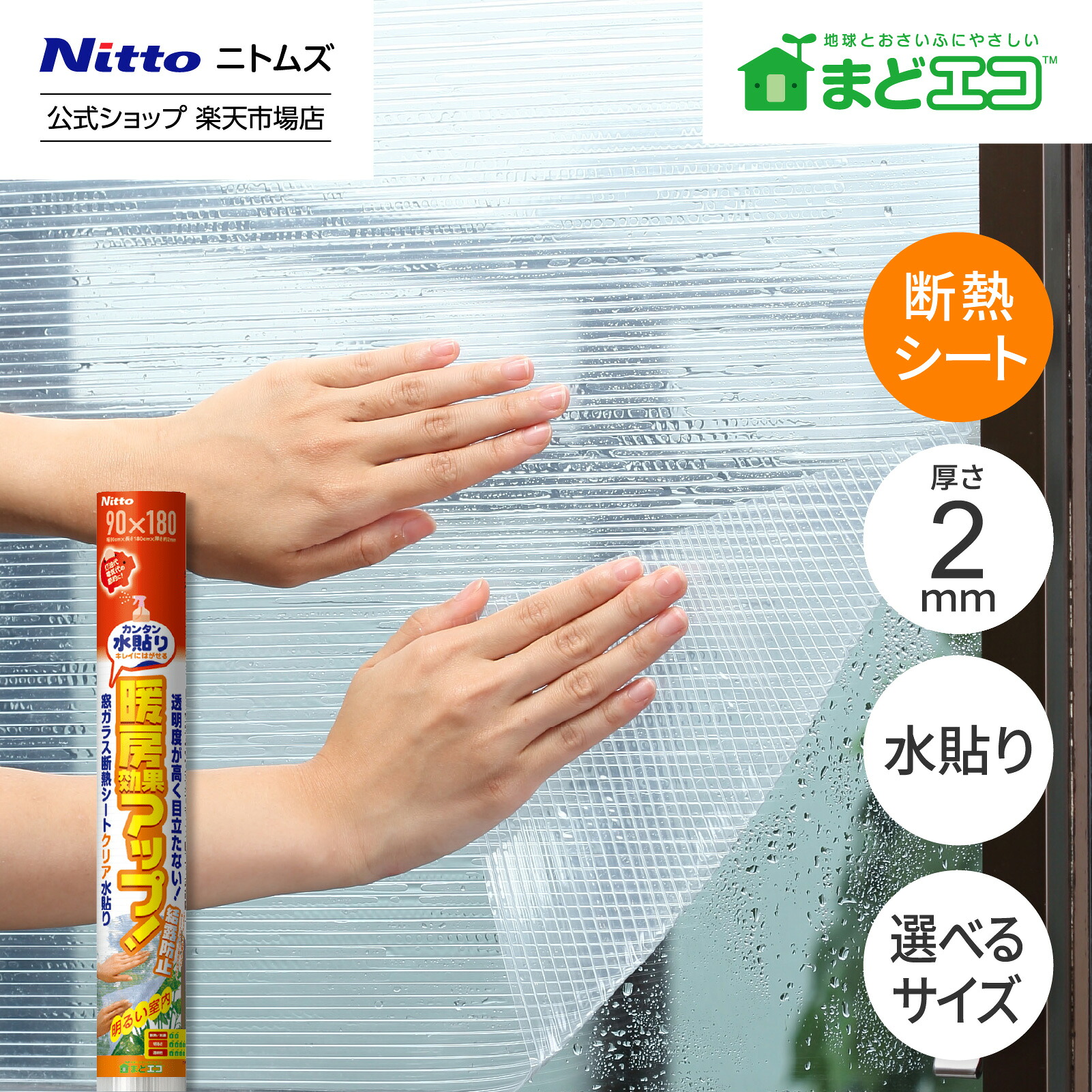
Nitoms E1540 Clear Water-Applied Window Insulation Sheet — One Sheet
Suitable single-pane glass: Nitoms E1540, JPY 1,850
- Good for
- Smooth, ordinary single-pane glass that still gets wet after reducing excess moisture. Use on undamaged, untreated indoor glass in a vertical window.
- Before you buy
- Official-shop price including tax, excluding shipping, checked October 14, 2026; Amazon Japan prices may differ. Not for Low-E, wired, vacuum double glazing, skylights, or places that stay wet. Keep stripes horizontal. Confirm any double glazing separately.
Specifications and terms
- Official-shop reference price
- JPY 1,850 including tax, excluding shipping (October 14, 2026); Amazon Japan prices may differ
- Size and quantity
- Approximately 2 mm × 90 cm × 180 cm; one sheet per pack
- Application
- Water application on indoor glass; keep stripes horizontal
- Recommended window
- Smooth, ordinary single-pane glass; vertical, undamaged, untreated, and able to dry
- Excluded glass and locations
- Low-E, wired, vacuum double glazing, existing shatterproof films, skylights, and places that stay wet; confirm ordinary double glazing separately
Sources
- Nitoms — E1540 clear water-applied insulation sheet
E1540 is one sheet, approximately 2 mm thick and 90 cm × 1.8 m. E1541 contains two sheets; E1550 is longer. Checked October 14, 2026.
- Nitoms — installation and glass suitability guide
Indoor use, cleaning, water application, horizontal stripes, and allowed or excluded surfaces. Smooth ordinary double glazing is listed as suitable; special glass is excluded. Checked October 14, 2026.
- Nitoms — energy-saving product FAQ in Japanese
Thermal cracking, excluded special glass including vacuum and gas-filled structures, remaining condensation, clear-sheet orientation, peeling, and seasonal replacement. Checked October 14, 2026.
- Nitoms — energy-saving product FAQ in English
English help for peeling, clear-sheet orientation, and drying. For precise glass restrictions, use the Japanese installation chart and Japanese FAQ together; the English glass wording is broader. Checked October 14, 2026.
- Nitoms official shop — one-sheet E1540 price
E1540 variant, JAN 4904140245405, one sheet, JPY 1,850 including tax and excluding shipping. This is an official-shop reference, not an Amazon price. Checked October 14, 2026.
- Japan Meteorological Agency — humidity and dew point
Dew point is the temperature at which air reaches saturation when cooled without changing its water-vapor pressure. Checked October 14, 2026.
- LIXIL — ventilation and insulation-film pitfalls
Ventilation, moisture from heating and humidifiers, uneven glass heating, and a household report of cracked wired glass. No health advice or humidity target taken from this page. Checked October 14, 2026.
- JAPANsociology — removing winter window coverings
April 1, 2012 household account mentioning bubble wrap and absorbent tape together. Product and measurement conditions are unknown; not an E1540 performance test. Read October 14, 2026.
Found an error or outdated information? Contact us or use our corrections form (opens in a new tab).