Key points
- Use your class's edition; keep a working 2nd-edition set for self-study.
- Starting fresh? Choose the 3rd-edition main text and English notes for the same volume.
- The two Elementary I books cost JPY 4,950 at publisher prices; extra practice audio costs more.
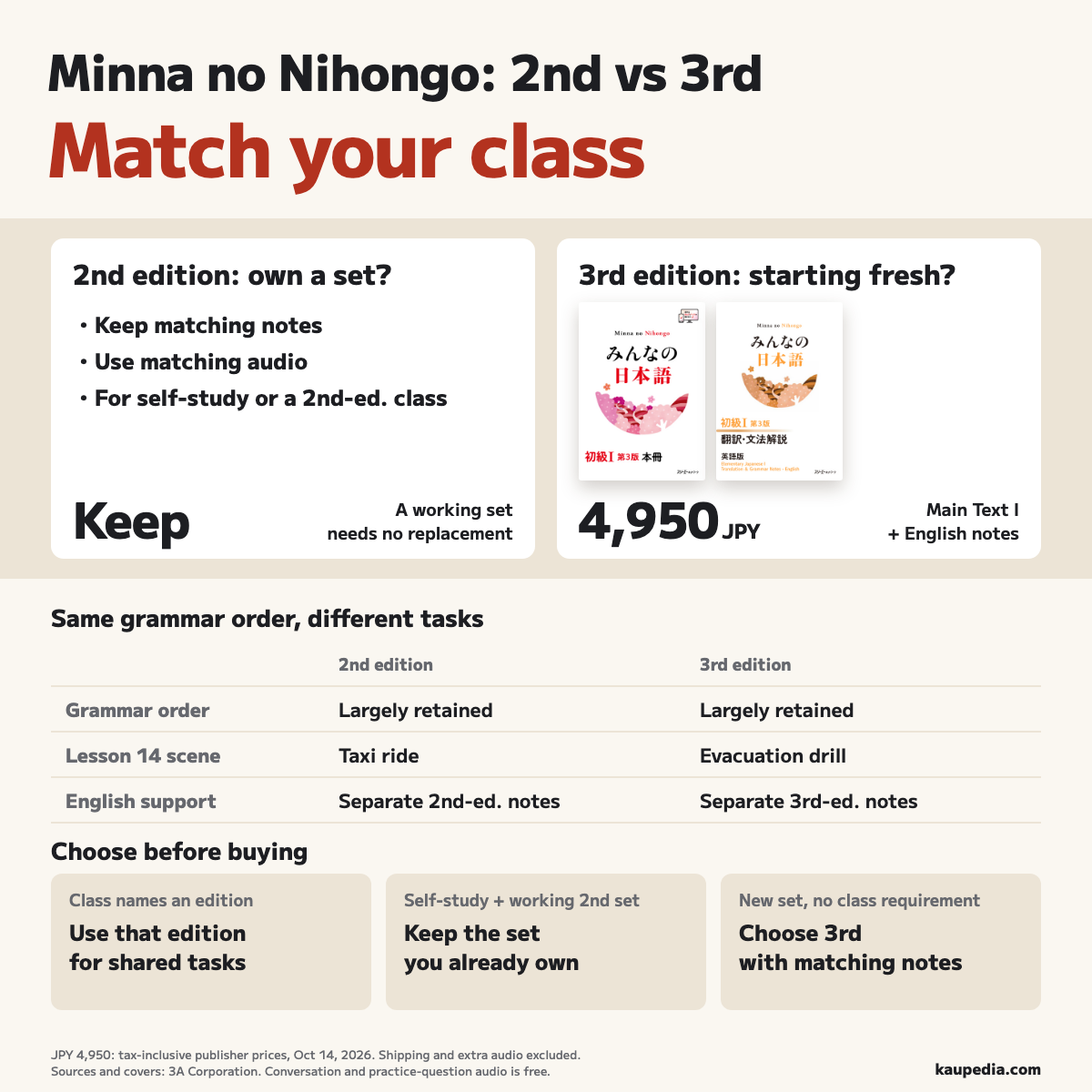
Use the Minna no Nihongo edition your class in Japan requires, and keep a working 2nd-edition set if you study alone. If you are buying your first set without a class requirement, choose the 3rd-edition main text and matching English Translation and Grammar Notes. The grammar order is largely unchanged, but new words and revised tasks mean that the same lesson number does not always mean the same homework.
Why the same grammar can lead to different homework
Imagine your teacher starts a conversation task, but your book puts the speakers in a different place. You may know the right sentence pattern and still be answering a different question. That is the main reason to match editions in a class.
The publisher's change list gives a clear example. In Elementary I, Lesson 14 changes from a taxi ride to an evacuation drill. Lesson 16 changes from using an ATM to using a swimming pool. The ATM topic remains in that lesson's Translation and Grammar Notes, so it has not vanished from the course.
These changes update the situations where you use Japanese. An evacuation drill is a useful scene for someone living in Japan. Yet learning an older taxi conversation still teaches useful Japanese. The revision gives you newer examples; it does not erase what you learned from the older book.
Words also move or change. The official vocabulary list adds words such as sumaho (smartphone), apuri (app), and SNS (social media). This matters when you reach for an English word list: a list for the older edition may no longer follow the new main text word for word.
The grammar topic can match while the task does not. Keep that distinction in mind when someone says the editions are “basically the same.”
What changed between the 2nd and 3rd editions?
Part | 2nd edition | 3rd edition | Your buying decision |
|---|---|---|---|
Beginner course | 50 lessons across I and II | Same broad structure and grammar order | Earlier study still counts. |
Conversations and words | Earlier scenes and word lists | Updated scenes; words added, removed, or moved | Use the notes for your edition. |
Reading tasks | Earlier passages and questions | Some revised passages and related tasks | Follow your class's assigned book. |
Main-text audio | Included CD; free web audio also available | Free web/app audio for conversations and practice questions | Match recordings to the book. |
Extra practice audio | Separate audio materials | Paid web/app audio for more sections | Do not budget as if all tracks were free. |
The change list also identifies a revised reading in Elementary I, Lesson 21, with changes to its related tasks. This is a concrete reason that matching lesson numbers are not enough for classwork.
Both editions keep English explanations in a separate companion. The 3rd edition does not turn the Japanese main text into an English-language textbook. If the Japanese instructions stop you before you can begin an exercise, buying only a newer main text will not solve that problem.
Which edition should you buy or keep?
Your school or teacher names an edition
Buy that edition, even if another one is cheaper. A class using the 2nd edition needs its matching main text and assigned supplements. A class using the 3rd edition needs the newer materials.
If you already own another edition, one question is enough: “Can I use this edition for your homework, including the English notes and audio?” Use it only if the teacher gives you a clear way to follow the tasks. A general “the grammar is similar” does not tell you which conversation to prepare.
You already own a matching 2nd-edition set
Keep it for self-study if its main text, English notes, and audio work together. The publisher still lists free web audio for the 2nd-edition main text. You do not need to replace your books just because your phone has no CD player.
You can use the publisher's vocabulary-change PDF to spot newer words. It separates additions, removals, and moves between lessons. Use it as a small update to your existing study, rather than treating every changed entry as a word you have never learned.
A Japanese tutor writing about the new edition in November 2025 described updating her lessons to fit her students and teaching online. Her account supports a useful distinction: the edition matters for shared tasks, while a teacher can also adapt a lesson. It does not mean every mixed set will work.
You are starting from zero
Choose the 3rd edition unless your class requires the 2nd. You get the updated situations and can buy the matching English notes without building your study around an older word list.
Start with Elementary I, which covers the first 25 lessons. Elementary II continues with the next 25. The volume number and edition number are separate: “II” means the second book, not “2nd edition.” There is no need to buy both volumes before you start.
Buy the main text and English notes as a matching pair
For Elementary I, allow JPY 4,950 for the two 3rd-edition paper books. That is the publisher's main-text price of JPY 2,750 plus JPY 2,200 for the English notes, including tax, checked on October 14, 2026. Shipping and extra workbooks are outside that total; Amazon Japan's selling price can differ.
The main text supplies the Japanese lessons and practice. It includes a separate booklet with example answers and question scripts. That booklet is not the English grammar companion. If your 3rd-edition class already gives you enough English support, the main text alone has a publisher price of JPY 2,750.
 View on Amazon Japan
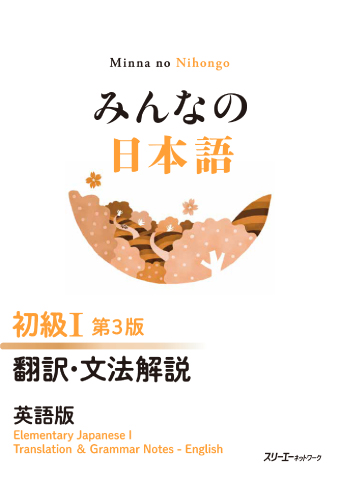
The English Translation and Grammar Notes explains the grammar and translates vocabulary, sentence patterns, examples, and conversations. If you already own the 3rd-edition Elementary I main text but need English help, adding this one book costs JPY 2,200 at the publisher's tax-inclusive price; you do not need another main text.
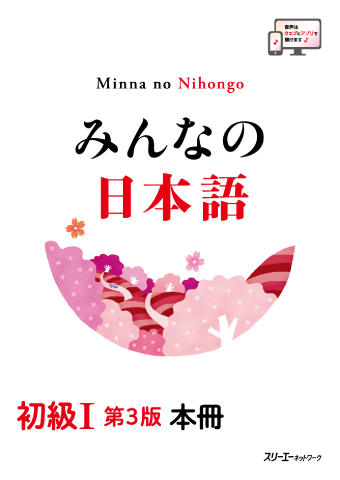
View on Amazon JapanMatch three labels: Elementary I, Third Edition, and English on the notes. On Japanese listings, honsatsu means the main text, while honyaku bunpo kaisetsu means Translation and Grammar Notes. Dai 2-han means 2nd edition and dai 3-pan means 3rd edition. Similar covers do not make the books a set.
When you reach Elementary II, its 3rd-edition main text and English notes have the same combined publisher price. Buying both volumes with their English notes totals JPY 9,900 before shipping or other materials. Buy the next pair when you need it, rather than spending that amount at the start.
Free audio is enough to start; extra tracks cost more
For the 3rd edition, conversations and practice-question recordings are free through the publisher's website or audio app. Elementary I also has free introductory recordings. Start with those tracks alongside the books.
The paid audio product adds sentence patterns, example sentences, Exercises A, B, and C, and new vocabulary. It is Japanese audio, including the vocabulary recordings; buying it does not give you spoken English grammar lessons.
For Elementary I, all paid lessons cost JPY 5,500 at the publisher's tax-inclusive price. Adding that to the two books brings the total to JPY 10,450. Individual lessons cost JPY 220, so you can begin without paying for every extra track.
The web version streams audio. The app sells lessons individually, and downloaded tracks can be used offline; its FAQ says there is no single purchase for all lessons. Choose the route that fits where you listen, and keep the edition label aligned with your book.
Common mistakes: mixed notes, missing booklets, and “all audio”
- Buying a cheap 2nd-edition main text with new 3rd-edition English notes. Compare the cost of a complete matching pair. A saving on one book may leave you with words and tasks that do not line up.
- Assuming every older workbook can move to the 3rd edition. The publisher recommends matching editions. It provides specific adaptation materials for the older Listening Comprehension Tasks 25 and Reading Comprehension Text 25. Those exceptions do not cover every supplement or make older English notes a matching companion.
- Buying used without the separate answer/script booklet. The main-text listing identifies that booklet. A low price is less useful if the pages you need to check your work are missing.
- Reading “free audio” as every recording. Conversations and practice questions are free; extra practice tracks cost more. Start with the free part and add paid lessons only when you need those recordings.
For a new set in Japan, the safest starting purchase is one main text and its matching English notes. For an existing set, replace only what your class or your missing materials require.
Where to buy
Check prices, availability, shipping, returns, and any subscription terms at the retailer. Links may include affiliate links.
Minna no Nihongo Elementary I Third Edition Main Text
New set or 3rd-edition class: Main Text I, JPY 2,750
- Good for
- Beginners starting Elementary I without an older-edition course requirement.
- Before you buy
- Japanese main text. English explanations are sold separately. Match the class, volume, and edition.
Specifications and terms
- Publisher price
- JPY 2,750 including tax (October 14, 2026)
- ISBN
- 978-4-86841-000-3
- Lessons
- 1–25
- Language
- Japanese (English notes sold separately)
Minna no Nihongo Elementary I Third Edition Translation and Grammar Notes — English
English support for 3rd-edition I: Grammar Notes, JPY 2,200
- Good for
- Learners using Elementary I Third Edition who want English translations and grammar explanations.
- Before you buy
- Companion book, not the main text. Choose English, Elementary I, Third Edition together.
Specifications and terms
- Publisher price
- JPY 2,200 including tax (October 14, 2026)
- Matches
- Elementary I Third Edition Main Text, Lessons 1–25
- Language and format
- English; B5 paper book, 181 pages
Sources
- 3A Corporation — third-edition changes
Revised conversations, vocabulary, and reading tasks; broad grammar sequence retained. Checked October 14, 2026.
- 3A Corporation — English third-edition FAQ
Edition matching, exceptions for selected older supplements, and web/app audio options. Checked October 14, 2026.
- Elementary I Third Edition — Main Text
First 25 lessons, separate answer/script booklet, free audio, and JPY 2,750 including tax. Checked October 14, 2026.
- Elementary I Third Edition — English Translation and Grammar Notes
Matching English companion, translations and explanations, JPY 2,200 including tax. Checked October 14, 2026.
- Elementary I Second Edition — Main Text
JPY 2,750 including tax, included CD, and free web audio. Checked October 14, 2026.
- Elementary II Third Edition — Main Text
Next 25 lessons and JPY 2,750 including tax. Checked October 14, 2026.
- Elementary II Third Edition — English Translation and Grammar Notes
Matching English companion and JPY 2,200 including tax. Checked October 14, 2026.
- Elementary I Third Edition — Audio Web.ver
Japanese streaming audio, included sections, and JPY 5,500 including tax. Checked October 14, 2026.
- Elementary I — vocabulary changes from the second edition
Added, removed, and moved vocabulary by lesson; smartphone, app, and SNS examples. Checked October 14, 2026.
- Selected second-edition supplements — materials for use with the third edition
Adaptation resources for Listening Comprehension Tasks 25 and Reading Comprehension Text 25, for both volumes. Checked October 14, 2026.
- Reiko Sensei — teaching with the third edition
Tutor's November 10, 2025 account of adapting textbooks to learners and online lessons; not a guarantee for mixed editions. Checked October 14, 2026.
Found an error or outdated information? Contact us or use our corrections form (opens in a new tab).