Key points
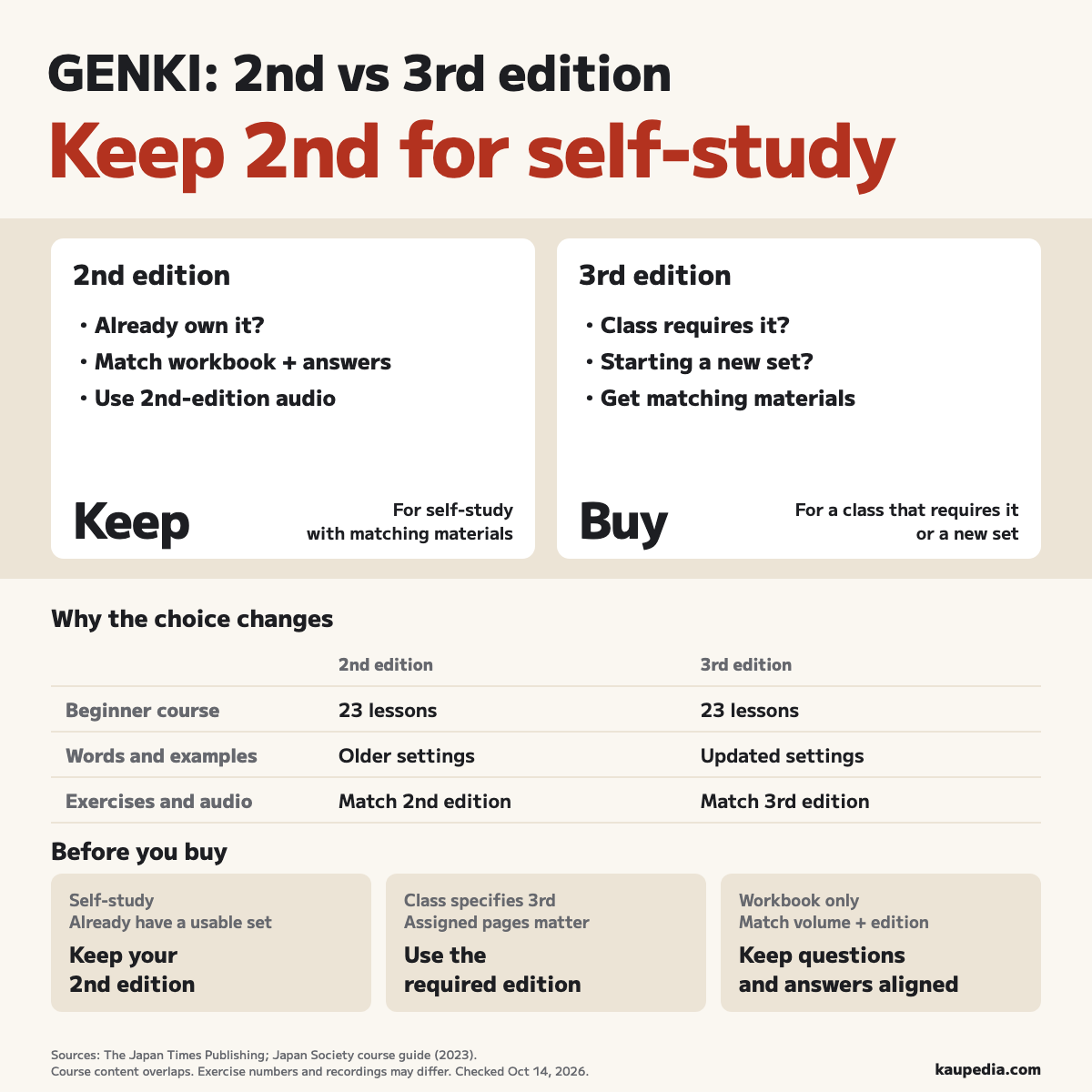
- Keep your 2nd edition for self-study if you have matching exercises, answers, and audio.
- Use the required edition for a class; similar grammar does not mean identical assignments.
- Match the workbook, answer key, and audio to the volume and edition you use.
Keep Genki 2nd edition for self-study if you already have the book and can use matching exercises, answers, and audio. Buy the 3rd edition if your class requires it, or if you are starting a new set without a strong reason to choose the older one. The beginner course is still similar, but revised words, examples, and exercises mean that learning the same grammar does not make the two editions interchangeable.
What changed in Genki 3rd edition?
First, separate the volume from the edition. Genki I is the first volume, covering Lessons 1–12. Genki II continues with Lessons 13–23. Each volume exists in both editions. Buying Genki II does not mean you are buying the second edition. The publisher's current guide lists the third-edition books and their lesson ranges.
Part of the course | 2nd edition | 3rd edition | What it means for you |
|---|---|---|---|
Lesson structure | 23 lessons across I and II | Same overall lesson split | Your earlier study still counts. |
Vocabulary and expressions | Earlier word choices and situations | Updated words; related words grouped together | Word lists do not match line for line. |
Grammar explanations and practice | Earlier wording and exercise layout | Revised explanations; practice headings show the grammar item number | A familiar topic can have a different question. |
Lesson openings | Earlier opening format | Clear learning goals | You can see what each lesson aims to teach. |
Readings and illustrations | Earlier readings and visuals | Some revised readings, new visuals, and more color | Pictures and reading tasks may differ. |
Audio | MP3 CD-ROM bundled with the paper books | Audio supplied through OTO Navi | Use recordings for your actual book. |
The publisher's revision outline explains the planned changes. It is a pre-publication document, so it should not serve as a complete list of every final edit. A 2021 review of the published Genki I confirms revised visuals and a more diverse cast. It also gives a concrete example: Lesson 5's reading replaces one of two postcards with a blog entry.
Why can an old book still work, yet cause trouble in class?
The revision updates the situations used to teach Japanese. The publisher's outline points to smartphones and convenience stores among the newer vocabulary. It also explains why scenes such as asking a stranger for the time needed a fresh look. Daily habits change, even when the beginner sentence patterns remain useful.
That is why you can keep learning from the older book. An older example does not erase your ability to form a sentence. But a teacher assigns a particular exercise, rather than the broad idea of practicing a grammar rule. The words in that question, its page, and the recording all matter.
Think of it this way: two books can teach the same skill without setting the same homework. If a classmate's answer refers to a different picture, your grammar may be fine while your response still misses the assigned task. This is the reason to match a class's edition.
Which edition fits your study setup?
You study alone and already own the 2nd edition
Keep it if you have a usable set. Here, that means a textbook you can read, suitable exercises, a way to check answers, and audio for the material you will use. You do not need to replace a working set simply because its examples are older.
In a WaniKani discussion from May 2022, an owner returned to an unused second-edition book and chose to keep it. Another contributor who had used the third edition felt that replacing an older book for its layout alone would not justify the cost. These are personal decisions, not proof that everyone should choose the cheaper edition.
If a used workbook already contains answers, it may be less useful for fresh practice. Include the condition of the workbook and the cost of missing materials when you compare sets. A cheap textbook can become a poor deal if you spend the saving on books that do not match it.
You are buying your first set
Choose the 3rd edition unless a course or a tutor has a clear reason to use the 2nd. Its revised layout, learning goals, and current publisher support give you a straightforward starting point. Buy the volume you need first. You do not have to buy Genki II before you begin Genki I.
For a price reference, the publisher lists the third-edition paper textbooks at JPY 3,960 each, the workbooks at JPY 1,870 each, and the answer key at JPY 880. These are Japanese prices including tax, checked on October 14, 2026. They are not US prices or delivered totals. The individual textbook, workbook, and answer-key listings identify the separate books.
If you live in Japan, Amazon Japan sells the same third-edition books at these prices. Outside Japan, check whether the listing offers delivery to your country before you order.
 View on Amazon JapanView on Amazon Japan
Your class specifies an edition
Use that edition. If it requires the 3rd edition, get the 3rd; if it requires the 2nd, follow that requirement. Only use another edition when the instructor explicitly allows it and provides a clear way to follow the assignments.
A Japan Society course guide from summer 2023 gives a real example. Its textbook section recommends the third edition because the second has different pages and examples. That is a historical example of the problem, rather than a statement about today's classes.
If you already own the old textbook, ask one specific question before buying: “May I use this edition, and which workbook and audio will homework use?” If the answer is no, the replacement has a clear purpose: keeping you aligned with the class.
You only need a workbook or answer key
Match both the volume and the edition. For a Genki I second-edition textbook, choose Workbook I second edition. For Genki II third edition, choose Workbook II third edition. This is the simplest way to keep the questions, vocabulary, and listening tasks together.
Some exercises overlap across editions, but that does not make a mixed set a reliable drop-in replacement. We recommend matching materials because it removes the need to work out which questions and answers still line up.
The answer key is a separate book. The third-edition listing says it covers textbook and workbook exercises for both volumes, plus workbook listening scripts. It is not sold as a universal key for older editions. Do not buy it expecting every second-edition answer to match.
View on Amazon JapanHow do you get the right audio?
The official app is OTO Navi — Sound Navigator. The publisher lists it as free. Its instructions let you search by title or ISBN, the identifying number printed near the book's barcode. Select the right volume, edition, and book type, then download the relevant tracks.
Textbook audio covers dialogues, vocabulary, selected practice, and readings. Workbook audio covers listening exercises. Downloading the textbook does not give you the matching workbook tracks. Before doing a listening task, check the recording against that task's heading and opening words.
For second-edition owners, the original paper-book listing describes an MP3 CD-ROM. You need a computer that can read its files; it is not a normal audio CD for a CD player.
Second-edition users also reported finding their audio in OTO Navi in 2020 App Store reviews. That history is useful, but the publisher warns that some older titles may not appear in today's app search. If you are buying a used set without discs, establish that you can obtain its matching audio before paying. Third-edition recordings are not a guaranteed substitute.
Common mistakes that waste money or study time
- Buying Genki II when you meant “second edition.” Look for the volume, edition, and whether the listing says textbook or workbook.
- Assuming the newer edition fixes every confusing explanation. A second-edition buyer found its explanations hard to follow. The 2021 review also identifies difficult explanations in the third edition. If one topic stops you, try another explanation of that topic before replacing your whole set.
- Treating old resource links as part of a complete set. Genki Study Resources now says its exercises were removed at The Japan Times' request. Old forum recommendations do not guarantee those exercises are still there.
- Buying another book to solve an app problem. Google Play reviewers report both successful downloads and failed searches or downloads. These reports do not show how often problems occur. Try the publisher's search and download steps with your exact book before deciding that its edition is the cause.
Keep a working set; buy the edition your class needs
The useful choice depends on what must match. An independent learner with a working second-edition set can keep studying. A student following third-edition assignments should use the required books. A new buyer should normally choose the third edition and keep its companion materials aligned.
Before spending, put your textbook, workbook, answer key, and audio titles next to one another. Compare the volume and edition labels, then identify what is actually missing. That gives you a concrete purchase decision: replace a required book, add one matching companion, or keep the set you already have.
Where to buy
Check prices, availability, shipping, returns, and any subscription terms at the retailer. Links may include affiliate links.
![GENKI: An Integrated Course in Elementary Japanese I [Third Edition]の表紙](/api/media/file/genki-2nd-vs-3rd-edition-genki1-3rd-cover-2de9c75f.jpg)
GENKI: An Integrated Course in Elementary Japanese I [Third Edition]
Starting Genki I with no set yet: the 3rd-edition textbook, JPY 3,960
- Good for
- New learners, and students whose class uses the 3rd edition.
- Before you buy
- Genki I covers Lessons 1-12. Check that the cover says Third Edition. Audio is free in the OTO Navi app.
Specifications and terms
- Publisher price
- JPY 3,960 including tax (October 14, 2026)
- Lessons
- 1-12
- Audio
- Free in the OTO Navi app
![GENKI: An Integrated Course in Elementary Japanese I Workbook [Third Edition]の表紙](/api/media/file/genki-2nd-vs-3rd-edition-genki1-workbook-3rd-cover-e70be994.jpg)
GENKI: An Integrated Course in Elementary Japanese I Workbook [Third Edition]
Using the Genki I 3rd-edition textbook: the matching workbook, JPY 1,870
- Good for
- Learners who want written practice and listening tasks that match the 3rd-edition lessons.
- Before you buy
- Buy the workbook for the same volume and edition as your textbook.
Specifications and terms
- Publisher price
- JPY 1,870 including tax (October 14, 2026)
- Matches
- Genki I, third edition
![GENKI: An Integrated Course in Elementary Japanese Answer Key [Third Edition]の表紙](/api/media/file/genki-2nd-vs-3rd-edition-genki-answer-key-3rd-cover-4362dba4.jpg)
GENKI: An Integrated Course in Elementary Japanese Answer Key [Third Edition]
Studying the 3rd edition alone: the answer key, JPY 880
- Good for
- Self-learners who need to check textbook and workbook exercises for both volumes.
- Before you buy
- It is for the 3rd edition. Second-edition answers will not all match.
Specifications and terms
- Publisher price
- JPY 880 including tax (October 14, 2026)
- Covers
- Genki I and II, third edition
Sources
- The Japan Times Publishing — third-edition revision outline
Pre-publication outline of the retained structure and planned changes to vocabulary, explanations, practice, and audio. Checked October 14, 2026.
- GENKI Online — structure, materials, and FAQ
Current lesson ranges, lesson goals, practice numbering, textbook and workbook audio, and separate study apps. Checked October 14, 2026.
- GENKI I textbook — third edition
English-language paper textbook; ISBN 9784789017305; Japanese list price JPY 3,960 including tax. Checked October 14, 2026.
- GENKI I workbook — third edition
ISBN 9784789017312; Japanese list price JPY 1,870 including tax; workbook audio supplied through OTO Navi. Checked October 14, 2026.
- GENKI II textbook — third edition
ISBN 9784789017329; Japanese list price JPY 3,960 including tax. Checked October 14, 2026.
- GENKI II workbook — third edition
ISBN 9784789017336; Japanese list price JPY 1,870 including tax. Checked October 14, 2026.
- GENKI answer key — third edition
Separate book for textbook and workbook answers in both volumes, plus workbook listening scripts; ISBN 9784789017367; JPY 880 including tax. Checked October 14, 2026.
- GENKI I textbook — second-edition legacy listing
Second-edition ISBN and bundled MP3 CD-ROM; the page explains that the disc is not a standard audio CD. Legacy prices are not current purchase quotes.
- GENKI I workbook — second-edition legacy listing
Workbook for the matching textbook; ISBN 9784789014410; listening exercise recordings on MP3 CD-ROM.
- GENKI II textbook — second-edition legacy listing
ISBN 9784789014434; original MP3 CD-ROM and Lessons 13–23. Legacy prices are not current purchase quotes.
- GENKI II workbook — second-edition legacy listing
Workbook for the matching textbook; ISBN 9784789014441; listening exercise recordings on MP3 CD-ROM.
- OTO Navi — publisher instructions and troubleshooting
Free audio app, search by title or ISBN, downloads, and the warning that some older titles may not be listed. Checked October 14, 2026.
- Japan Society — summer 2023 course guide
Historical classroom example; required-textbook section explains edition differences in pages and examples. It does not establish current course requirements.
- Ryan Francis Lidster — review of GENKI I third edition
Japanese Language and Literature, April 2021, pages 373–378. Direct review of visuals, revised characters, the Lesson 5 blog reading, and remaining limitations.
- WaniKani — keeping an existing second edition
May 2022 discussion; separate learners weigh existing ownership, layout, and the cost of replacing books. Individual opinions, not a survey.
- WaniKani — second or third edition
January 2021 discussion; includes a second-edition buyer who found its explanations hard to follow.
- WaniKani — first impressions of the third edition
February 2020 owner report on lesson goals, layout, and updated situations. Used as personal observations, not a complete change list.
- OTO Navi — App Store user reviews
Two 2020 reviews describe accessing second-edition GENKI audio; a 2024 review reports a favorites problem. Historical availability does not guarantee today's catalog.
- OTO Navi — Google Play user reviews
Individual GENKI users report successful barcode search and failed search or downloads. Checked October 14, 2026; not treated as failure-rate data.
- nihonstation — GENKI II textbook and workbook review
A learner's December 2017 account of using the earlier books; does not compare them with the later third edition.
- Genki Study Resources — current exercise-removal notice
The site's own notice says its exercises were removed at The Japan Times' request. Checked October 14, 2026.
Found an error or outdated information? Contact us or use our corrections form (opens in a new tab).