Key points
- Measure room temperature and humidity before buying a humidifier; cold glass can get wet even when the room air feels dry.
- Use repeated room readings and visible water together. A reading between 30% and 50% does not guarantee dry windows.
- Keep a meter you already own. Choose the Tanita TT-559 if you need one and can read its screen in a well-lit place.
If your home in Japan feels dry but the windows are wet, measure temperature and humidity before buying a humidifier. Warm room air can have low relative humidity while a cold window is cool enough for water to form on it. If you have no meter and can read it in a well-lit place, choose the Tanita TT-559; otherwise, use the meter you already own.
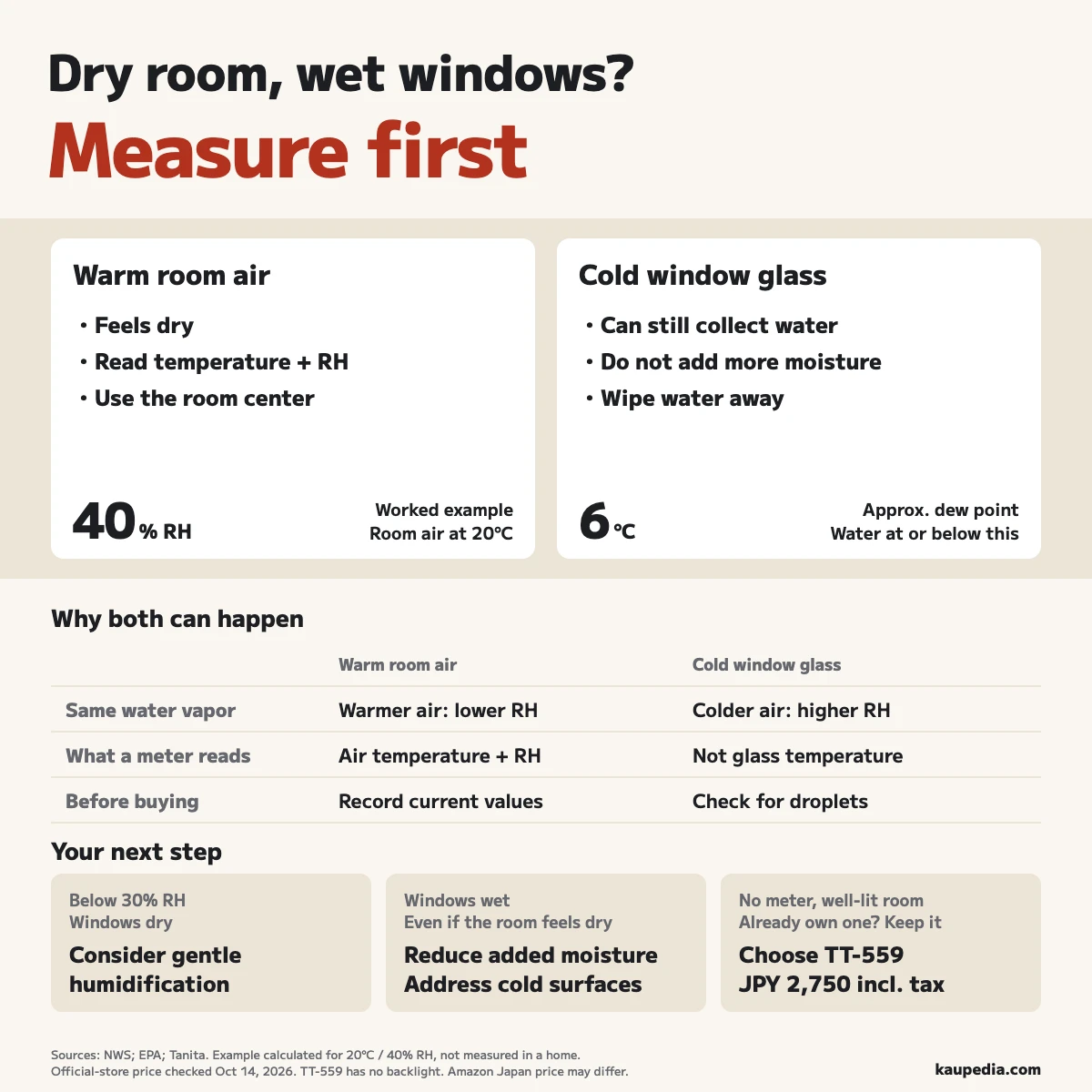
Why a dry room can still have wet windows
The percentage on a humidity meter changes with temperature. It compares the water vapor in the air with the amount needed for that air to become fully saturated at its current temperature. This is called relative humidity, or RH.
When your air conditioner heats a room without adding moisture, RH falls. That falling percentage alone does not mean the heater removed water. Daikin explains this difference in its guide to dry winter air.
Near cold glass, the air cools and its RH rises. If it cools far enough, water forms on the surface. The temperature where this starts is the dew point.
Here is a worked example: air at 20°C and 40% RH has a dew point of about 6°C. Glass at that temperature or below can collect water even though the room reading looks fairly low. A cold metal frame may also be wet when nearby glass is dry.
This explains the apparent puzzle: your room can feel dry while your window is wet. Raising humidity can increase the water on that cold surface. The room percentage and the condition of the window both matter.
Record the room first, then compare the window area
Start where you spend time, away from the window, direct sun and air blowing from a heater or humidifier. A shelf near the middle of the room is more useful for a room reading than the windowsill.
For your first record, take readings on two ordinary days. Read the meter when you wake up and while the heating is running in the evening. This is a simple starting routine, not a scientific test or a rule about how many readings every home needs.
Write one line each time: time, location, current temperature, current RH, heating on or off, and window dry or wet. Add a short note if you have been cooking, bathing or drying laundry indoors. Those activities can change the result.
Then compare the room with a safe, dry spot near the window. Keep the meter off wet frames and do not press it against the glass. Let it settle after moving it. A single meter works, but those readings happen at different times; take another room reading afterward if conditions have changed.
If you already own two meters, place them together first to see whether they disagree, then use one at each location. A small difference between devices can come from their accuracy limits. Buying a second meter is optional.
The window-area reading describes nearby air. It does not measure the glass temperature or prove that the entire room needs drying. For the buying decision, use the room reading and note where water appears.
Choose the next step from the reading and the window
Use the following table as a starting point. The EPA gives 30% to 50% as general home humidity guidance, but your coldest surfaces may need less moisture to stay dry.
Repeated room reading and window condition | What to do first | What to buy next |
|---|---|---|
Below 30% RH, with dry windows | Consider gentle humidification and watch for new droplets | A humidifier may be useful |
Around 30–50% RH, with dry windows | Keep observing; move out of direct warm airflow if it bothers you | No urgent humidifier purchase |
Wet windows, even with a low room reading | Reduce any added moisture, wipe water away and address ventilation and cold surfaces | Hold off on a humidifier or dehumidifier until the pattern is clearer |
Above 50% RH, especially with wet windows | Stop adding moisture and remove it at the source | Consider dehumidification only if damp conditions persist |
These are action guides, not sharp pass-or-fail lines. One reading near a boundary is too little reason to buy an appliance. Visible water takes priority over trying to reach a chosen percentage.
If the room stays dry and the windows stay clear, use our steam-versus-hybrid humidifier guide for Japan to choose by cleaning work and room size. Keep checking the windows as you start using it. The EPA advises reducing humidifier use when condensation appears.
If moisture remains high after you stop humidifying, look at indoor laundry and bathroom or kitchen steam before choosing a dehumidifier. Buying a machine without addressing those sources can leave the same problem in place.
The TT-559 suits a well-lit room, not a dark bedside
The grey Tanita TT-559 displays temperature and humidity and stores their highest and lowest values. It is a simple choice for checking a room by day. It has no backlight, so choose a lit-screen model instead if you need to read it without turning on a light.
In Japanese listings, 温湿度計 means a temperature-and-humidity meter. 湿度 is humidity, and 温度 is temperature. Choose a device that shows both: a percentage without its temperature gives you only half the picture.
The TT-559 manual specifies a height of about 1.5 metres and around 30 minutes to settle after installation. Allow settling time after changing locations too.
If you need a first meter for these two daily checks, the TT-559 is enough for that job. Tanita's official store lists it at JPY 2,750 including tax, checked October 14, 2026. That is a price reference for your budget; the button opens the grey model on Amazon Japan, where price and stock may differ.
 View on Amazon Japan
Read the current values, and use memory carefully
Press MAX/MIN once for the highest values, again for the lowest, and again for the current readings. To clear a memory, hold the button for about three seconds while that MAX or MIN screen is showing. Clear both screens if you want a fresh period.
The highest temperature and highest humidity can occur at different times. Pair the current readings in your notes; memory values cannot tell you exactly what happened while you slept.
The screen labels 乾燥, 快適 and 不快 mean dry, comfortable and uncomfortable. They describe the meter's preset bands, not whether your windows will stay dry.
Accuracy matters too. The specified humidity error is ±5 percentage points within 35–75% RH and ±10 outside it. Treat a small change as a reason to keep observing, rather than a new buying decision.
Avoid the fixes that add to the problem
Running a humidifier harder because your throat feels dry can leave more water on already wet glass. A dry feeling alone cannot tell you the room's RH. Measure first, and reduce humidification if droplets appear.
Moving the meter onto a cold sill can create the opposite mistake: a high local reading that makes you think the whole room needs a dehumidifier. Keep a regular room location for comparisons.
Sealing an air inlet to keep out a cold draft can also trap moisture. Keep the apartment's installed ventilation working, and use kitchen and bathroom exhaust to remove steam near its source. Window insulation can help keep inner surfaces warmer, but any film must suit the glass and your rental conditions.
Wipe water from the glass, frame and sill when you find it. If a wall stays wet, stains spread, or water appears after rain, send photos and your reading notes to the property manager so the cause can be investigated.
For tonight, make one room record and note whether the window is wet. That gives you a useful starting point for the next check, before you spend money on adding or removing moisture.
Where to buy
Check prices, availability, shipping, returns, and any subscription terms at the retailer. Links may include affiliate links.
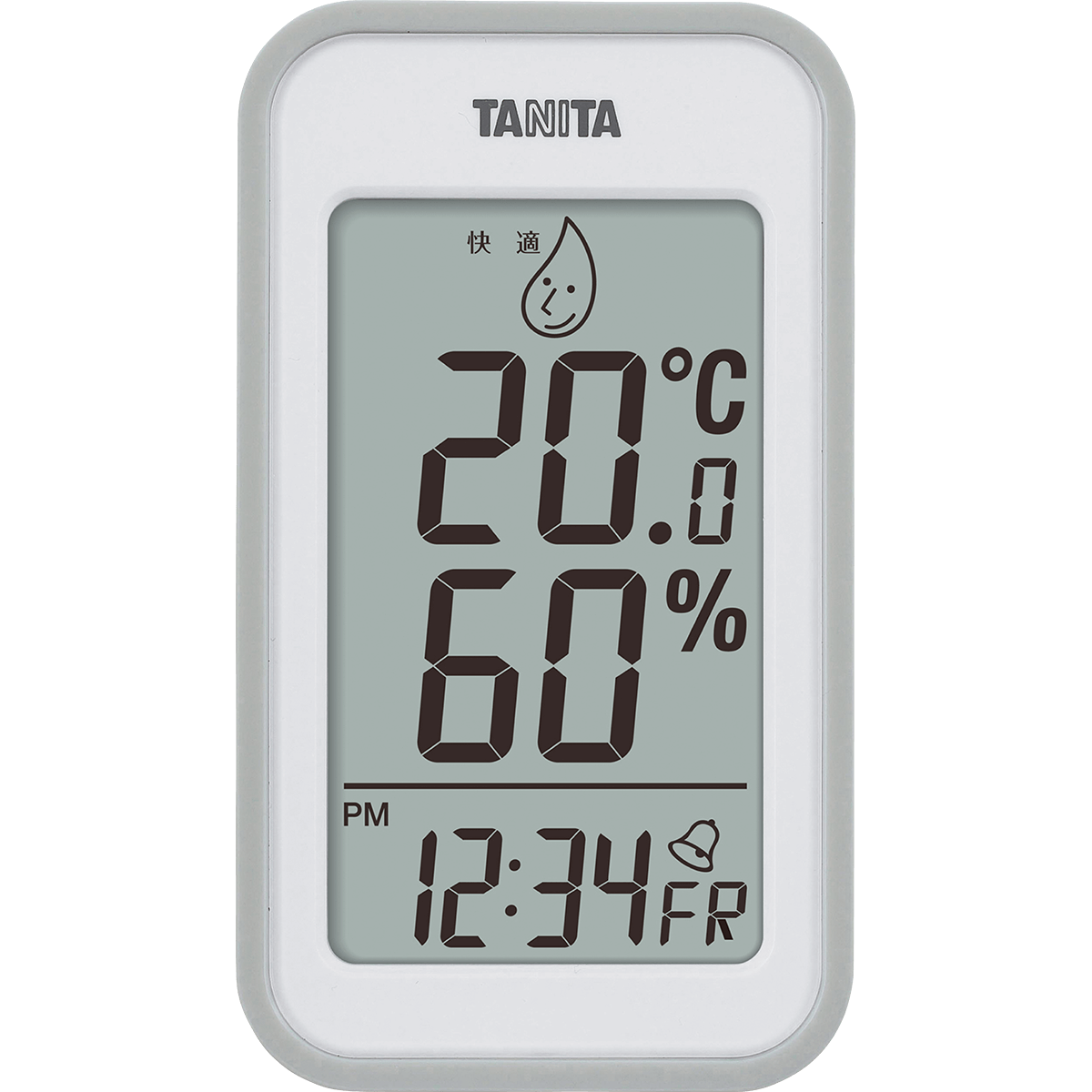
Tanita TT-559 Digital Temperature and Humidity Meter — Grey
No meter, well-lit room: Tanita TT-559, JPY 2,750
- Good for
- People who need temperature and humidity readings, plus the highest and lowest values recorded since reset.
- Before you buy
- Official-store price including tax, checked October 14, 2026; Amazon Japan prices may differ. No backlight. The meter measures air, not window surface temperature.
Specifications and terms
- Official-store price
- JPY 2,750 including tax (October 14, 2026); Amazon Japan price may differ
- Model and colour
- TT-559 GY / Grey
- Power
- One AAA battery
- Memory
- Highest and lowest temperature and humidity since reset; no time-stamped history
- Screen
- No backlight; read in a well-lit place
Sources
- Tanita TT-559 user manual
Pages 10, 12, 13 and 15 explain memory, screen labels, placement and accuracy. Checked October 14, 2026.
- Tanita Japan online store — TT-559
Grey model and official product photo; displayed price JPY 2,750 including tax, with SOLD OUT shown. Checked October 14, 2026.
- Daikin — why heating lowers relative humidity
Heating changes relative humidity even without removing water vapor. Checked October 14, 2026.
- National Weather Service — relative humidity and dew point
Relative humidity depends on temperature; dew point describes when cooling brings air to saturation. Checked October 14, 2026.
- Vaisala — dew point calculation
Formula used for the worked example of 20 degrees Celsius and 40% RH, giving approximately 6 degrees Celsius. Checked October 14, 2026.
- US EPA — use and care of home humidifiers
Avoid humidifying above 50% relative humidity; reduce use when water condenses on windows or other surfaces. Checked October 14, 2026.
- US EPA — care for your air
General home humidity guidance of 30% to 50%, rather than a guarantee against condensation. Checked October 14, 2026.
- US EPA — moisture control at home
Moisture sources, exhaust ventilation and warmer interior glass as ways to reduce condensation. Checked October 14, 2026.
- TT-559 owner report — reading the screen in the dark
An owner reports that the screen has no light and cannot be read in a dark room. Japanese-language page, checked October 14, 2026.
Found an error or outdated information? Contact us or use our corrections form (opens in a new tab).