Key points
- Keep your first edition when its notes and examples answer your questions.
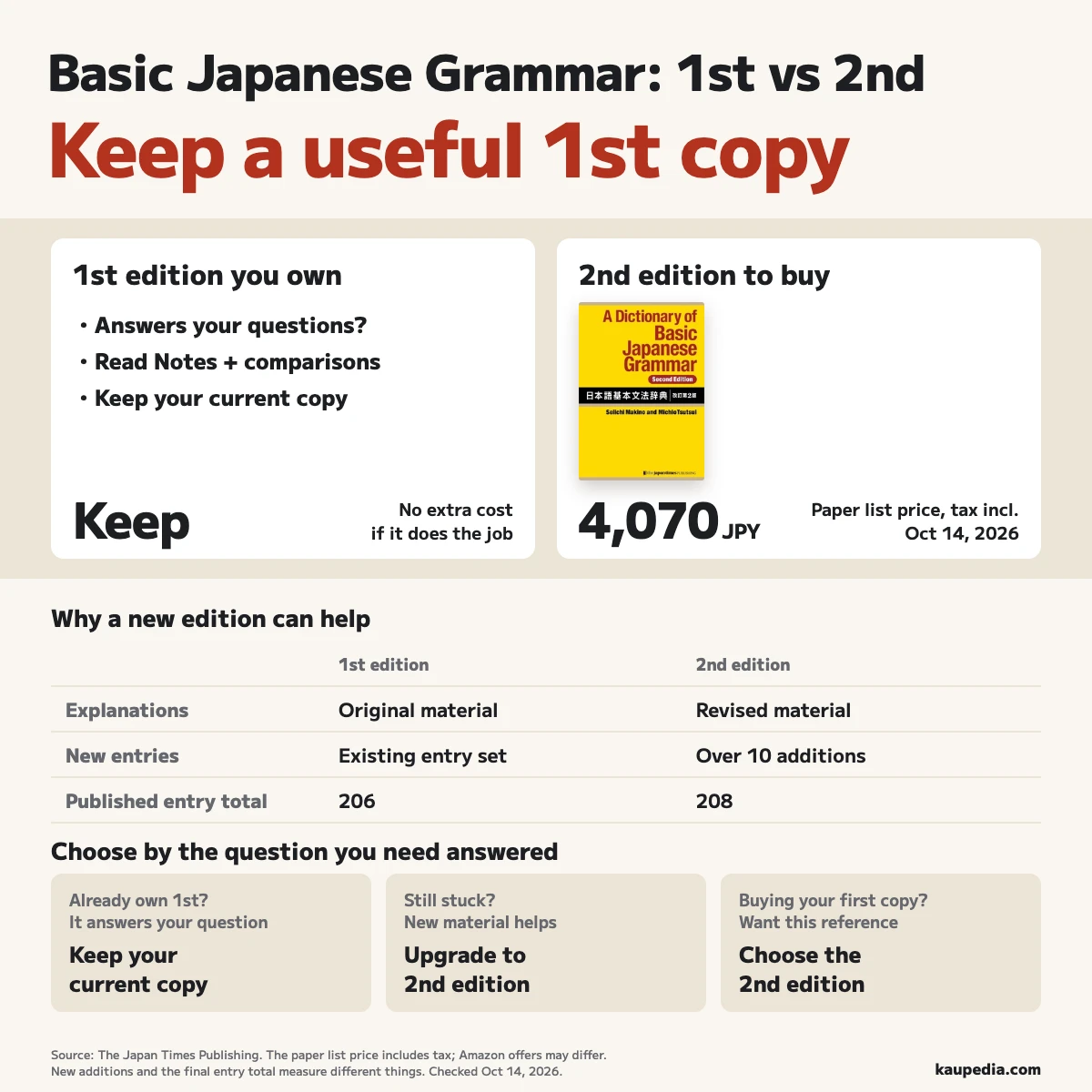
- Choose the second edition for your first copy or for revised material you need; the paper list price is JPY 4,070 including tax.
- More than 10 new entries does not mean 10 more entries overall; use an actual grammar question to judge the upgrade.
Keep your first edition of A Dictionary of Basic Japanese Grammar if it still answers your questions; choose the second edition for your first copy or a useful upgrade. The update adds clearer explanations and new entries, so an old printing date alone is a poor reason to replace a working reference. If you live in Japan, compare the revised material with a question you actually have before spending JPY 4,070 on the new paper edition.
Why the old edition can still be useful
A grammar dictionary earns its place by answering a question. You might understand most of a message from your landlord but be unsure how one phrase connects to the rest. A short English translation gives you the meaning; a fuller explanation helps you understand why that form fits.
The first edition already has more than quick translations. Its official sample shows key sentences, rules for building the expression, examples, notes, and comparisons with related expressions. If you stop after the English meaning at the top, you may miss the answer further down the entry.
That matters when deciding whether to replace it. Try the notes and related expressions in your current copy before treating a difficult sentence as a gap in the book. An older copy with familiar tabs and useful notes can still do the job you bought it for.
The date can also be confusing. The original book appeared in 1986, while the publisher dates its first paperback edition to 1989. A later reprint of that paperback is still the first edition. The second edition is the revised book published in 2025, rather than simply another printing.
What changed in the second edition
The publisher describes a broad revision: clearer explanations, newer example sentences, new entries, and changes to the opening grammar guide and appendixes. Named additions include da, naru, and Question word + ka. These are useful places to look when deciding whether the update addresses your own questions.
There is a surprising detail in the official listings. The publisher says it added more than 10 entries, yet the total rises from 206 to 208. Those numbers describe different things: new headings and the final total. They are not a complete list of what changed, and the listings do not explain every change behind the totals.
What matters for your choice | First edition | Second edition |
|---|---|---|
Published entry count | 206 | 208, with more than 10 newly added entries |
Explanations and examples | Original material you may already know | Revised explanations and updated examples |
Opening guide and appendixes | Original sections | Extensively updated sections |
Cost if you already own the first edition | JPY 0 to keep using it | JPY 4,070 paper list price, including tax |
The practical value is in the explanation you need, not the total number of headings. Someone who keeps getting stuck on the same basic form may gain more from a rewritten entry than from several extra expressions they rarely meet.
The revision also reflects later research on Japanese grammar. That gives a teacher or a learner who enjoys detailed explanations a reason to explore it. For everyday use, the useful test is simpler: does the explanation help you understand the sentence in front of you?
Use one real question to choose your edition
An owner who posted a first look at the new edition described separate entries for da and naru. They reported that the first edition discussed da mainly under wa ... da, while the new entry gives it fuller attention. Their post was a first impression, not a complete comparison.
The buying lesson is that a familiar word can receive a more useful explanation. You do not have to be learning a completely new expression for the revision to help. Equally, learning a new grammar label is a weak reason to spend money if your current explanation already lets you understand and use the form.
Use this decision path:
- Your copy answers your questions: keep the first edition. Read its notes and related expressions when a short definition leaves you stuck.
- A repeated question remains, and the revised material answers it: choose the second edition. A bookstore copy is useful for comparing the relevant entry with your old one.
- You want this reference and have no copy yet: choose the second edition. You get the revised material without paying to replace a book that already works.
For an owner, make the test concrete. Bring one sentence you could not understand and the name of the form that caused trouble. Read the old entry fully, then compare the relevant new entry if you can see a copy. Prefer the explanation that helps you explain your sentence in plain English.
For a first copy or an upgrade that solves a repeated question, the second-edition paper book has a list price of JPY 4,070 including tax, shown on the publisher's paper-book page on October 14, 2026. The button below opens that edition on Amazon Japan, where the selling price and delivery terms may differ.
 View on Amazon Japan
Judge the cost by how often you will look things up
If your first edition works, keeping it costs nothing extra. The useful comparison is the price of an upgrade against the questions it would help you answer. A discount on a new book does not make your old one stop working.
For a simple planning example, suppose you use the revised book twice a week for a year. That is 104 lookups. Dividing its JPY 4,070 list price by those lookups gives about JPY 39 each. At one lookup a month, the same calculation gives about JPY 339 each.
These are example budgets, not measured study results. They also count every lookup, even one your old copy could handle. For an upgrade, ask how often the revised material would add something useful. Regular use supports the purchase more strongly than a book you expect to open only occasionally.
If you read Japanese messages for work, study, or daily life, keep a short note of questions that return. A repeated question gives the dictionary a clear job. If it mainly sits closed while your course book answers everything you need, wait until a real gap appears.
Avoid the common buying and study mistakes
Choosing by cover colour. The revised Basic book has a yellow cover, unlike the familiar red first edition. Look for Basic and Second Edition together. Intermediate and Advanced are separate volumes, so colour alone is a poor guide to the book you want.
Expecting a course from a dictionary. A reference is useful when you bring it a question. For a learner starting from zero, a course with lessons and practice gives a clearer study order. Add this dictionary when you want more detail about forms you are already meeting.
Stopping at the first translation. Read the formation rules and notes before deciding that the old edition cannot help. The related-expression section is especially useful when two forms seem to mean the same thing in English.
Mixing paper and digital prices. The publisher's digital store sells access for a limited period. Its price and access rules belong to that service. The purchase button here is for the paper book, which you can use without that subscription.
If you need a first copy or the revised explanation solves your problem, budget JPY 4,070 for the second-edition paper book at the publisher's listed price. Open the Amazon Japan listing to see the offer for your address in Japan, with delivery costs included in your buying decision.
View on Amazon JapanStart with one sentence that has been bothering you and read the matching entry in the copy you already have, or in a bookstore copy if you are buying your first one.
Where to buy
Check prices, availability, shipping, returns, and any subscription terms at the retailer. Links may include affiliate links.
![A Dictionary of Basic Japanese Grammar [Second Edition]の表紙](/api/media/file/basic-japanese-grammar-dictionary-editions-basic-2nd-official-560aee14.jpg)
A Dictionary of Basic Japanese Grammar [Second Edition]
First copy or useful upgrade: Basic Japanese Grammar 2nd edition, JPY 4,070
- Good for
- Learners in Japan buying their first grammar reference, or owners who need the revised explanations and new entries.
- Before you buy
- Choose the paper book marked Basic and Second Edition. Keep a useful first edition; Intermediate and Advanced are separate volumes.
Specifications and terms
- Publisher list price
- JPY 4,070 including tax (October 14, 2026)
- Edition and format
- Second edition, paper book; published August 5, 2025
- Language
- English explanations and example translations; Japanese examples with romanization
- ISBN
- 9784789019095
Sources
- The Japan Times Publishing — second-edition paper book
Paper edition published August 5, 2025; English explanations; 208 entries; 792 pages; list price JPY 4,070 including tax. Checked October 14, 2026.
- The Japan Times Publishing — first-edition paper book
First paperback edition published March 20, 1989; 206 entries; 648 pages; English explanations and romanized examples. Checked October 14, 2026.
- The Japan Times Publishing — first-edition sample
To the Reader explains the entry structure, Notes, Related Expressions, and the three indexes. Sample PDF page 3 viewed October 14, 2026.
- National Diet Library — edition history
Records the revised second edition and identifies the original as published in 1986. Checked October 14, 2026.
- The Japan Times Publishing — second-edition revision and digital format
More than 10 new entries, including da, naru, and Question word + ka; revised explanations, examples, introduction, and appendixes. This store sells limited-term digital access, not the paper book. Checked October 14, 2026.
- Reddit — an owner's first look at the second edition
August 28, 2025 post discusses the standalone da and naru entries and explicitly limits its scope. Used as an individual owner's report, not a full comparison or proof of learning gains.
- WaniKani — owners discuss replacing the first edition
Owners ask what improved and whether replacement is worthwhile; one reports giving away the old edition after upgrading. Checked October 14, 2026.
Found an error or outdated information? Contact us or use our corrections form (opens in a new tab).